
Don't Coach Labels. Coach Development.
"He's such a talent" is one of the most common phrases in youth basketball — and one of the least helpful. Four questions to ask instead.
July 26, 2026
What if one of the most common phrases in youth basketball is also one of the least helpful?
"He's such a talent."
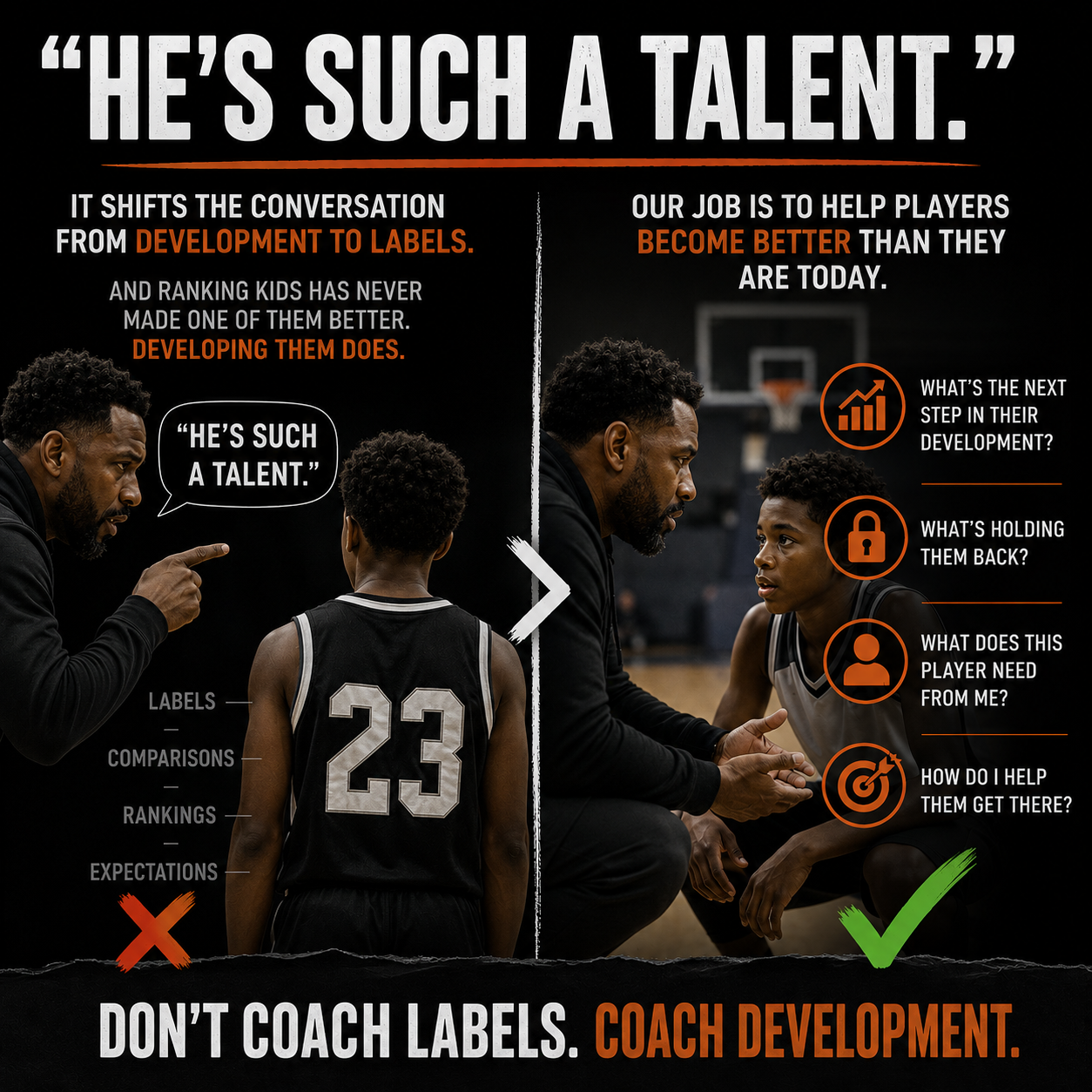
It sounds like praise. It sounds like a coach who knows what they're looking at. But listen to what it actually does: it shifts the conversation from development to labels.
Where That Conversation Goes
One label rarely stays a label. It starts a chain:
Labels → Comparisons → Rankings → Expectations
First a kid gets described. Then they get measured against a teammate. Then they get placed in an order. Then everyone starts treating that order as a prediction, and the prediction starts doing the work that coaching was supposed to do.
And here's the thing worth sitting with:
Ranking kids has never made one of them better. Developing them does.
A Label Is a Verdict. Development Is a Direction.
A label describes a kid as if they're finished. Talented. Athletic. Skilled. A shooter. Not a shooter. Not quite there yet.
Every one of those is a snapshot of a twelve-year-old — treated as a conclusion about a person who will change more in the next three years than most adults change in a decade.
The problem isn't that labels are always wrong. It's that they're the wrong kind of information. Once a kid has been sorted, the interesting question quietly stops getting asked.
Four Questions That Replace the Label
Our job is to help players become better than they are today. That's it. And you can run that job off four questions, asked about every kid on the roster — the best one and the twelfth one.
1. What's the next step in their development?
Not "how good are they?" but "what's the very next thing?" This has an honest answer at every level of player, which is exactly what a ranking doesn't have. "Third-best player on a 5th-grade team" gives you nothing to do on Tuesday at practice. "Her next step is closing out under control instead of flying by" gives you the whole session.
2. What's holding them back?
The interesting answer is usually not the obvious one. A kid who won't shoot may not have a mechanics problem — they may have a confidence problem, or a coach who took them out the last two times they missed. A kid who plays out of control may be trying to justify their minutes.
Diagnose before you prescribe. Most development plans fail because they solve the visible symptom.
3. What does this player need from me?
Different kids need different things from the same coach. Some need pressure and a higher bar. Some need to be told they're allowed to fail. Some need reps in a spot nobody's giving them reps in. Some just need to be looked at.
This is the question that separates coaching a team from coaching the twelve people on it.
4. How do I help them get there?
The step where good intentions usually die. If the answer isn't specific enough to change what happens at the next practice — the drill, the reps, the role, the feedback — it isn't a plan yet.
Why the Labels Are So Often Wrong Anyway
They mistake early for good
At these ages, a lot of what reads as "talent" is a head start. The kid who's six months older, or who hit their growth spurt first, dominates a 6th-grade game for reasons that have nothing to do with their ceiling. It catches experienced coaches constantly.
Meanwhile the smaller kid who has to actually solve problems to score is building skills that matter enormously at sixteen — and getting overlooked at twelve.
They decide who gets developed
The kid tagged as "the talent" gets the ball, the reps, and the benefit of the doubt after a bad game. The kid who didn't get tagged sets screens and stays in the corner.
Two seasons of that and the gap is real — but it isn't a gap in ability. It's a gap in opportunity that everyone will now point to as proof the labels were right all along.
They make effort feel risky
This is the part that hurts the labeled kid. If your identity is "the talented one," struggling in front of people threatens who you are. So you avoid the hard thing. You take the shot you already make.
A kid told they're improving fast can afford to be bad at something on the way to being good at it. A kid told they're a talent often can't.
For Parents
The same chain runs at home, and it runs on flattering labels too.
- Notice when you're repeating one. "You're a natural" is a heavier thing to carry than it sounds.
- Ask about the work, not the ranking. "What are you working on?" beats "How'd you play?"
- Go easy on comparisons to teammates. Kids are already running that scoreboard in their heads.
- Treat a bad stretch as information, not identity.
The Kids Who Get Missed
Every gym has them. The kid who developed late and got quietly written off at eleven. The kid whose best attribute — competitiveness, coachability, the ability to keep their head when things go badly — doesn't show up in a tryout evaluation.
Some of them are the best players on their high school teams five years later. Not because someone spotted the talent early, but because someone kept developing them after the label said not to bother.
The Takeaway
Labels feel like expertise. They're usually just a shortcut.
Our job is to help players become better than they are today.
Don't coach labels. Coach development.
Ready to Find Tryouts?
Browse our directory of upcoming AAU basketball tryouts in Washington State.
Find Tryouts Near Me